
3 Months, 6,000 Emails: The Honest B2B A/B Testing Guide
Published: Feb 20, 2026|11 min read|

Introduction
Forget the 'instant success' stories. It took me 3 months and 6,000 emails to find one winning pattern. Here is the raw reality of A/B testing.
Most online guides make A/B testing sound incredibly easy: just compare Pattern A against Pattern B, pick the winner, and watch your business grow. However, after spending 3 months running actual tests on a B2B newsletter, I quickly learned a harsh truth: textbook theories rarely work exactly as promised in the real world.
When you finally sit down to run an A/B test yourself, do you ever feel stuck with questions like:
There is a massive gap between understanding A/B testing in theory and actually making it work to get real business results.
I was once in that exact same position. I knew the marketing words, but I didn't know how to do the actual data work. I started from zero, hitting walls and making mistakes as I ran my first tests. This article is a practical guide for marketers who want to try A/B testing but don't know the real-world rules yet.
💡 Why read this guide?
This isn't just another textbook summary. This guide is based on real data from a 3-month B2B newsletter test. By showing you the reality of how long tests take and how much data you really need, this guide will help you avoid common mistakes.
In the first half, I’ll share a "basic blueprint" to help you plan good tests. In the second half, I will share the "reality of the numbers," including the long wait times I faced during my 3-month test. Let’s look at reality so you can take your first step with confidence.
Chapter 1: What is A/B Testing?
The Basic Concept
How A/B testing works is very simple. You create a Pattern A (Original) and a Pattern B (Variation) by changing just one thing (like a title or an image). You then randomly show these to users and check the data to see which one brings better results (like more clicks or sales).
The best part of A/B testing is that you can make decisions based on actual user data, so you don't have to guess or rely on someone's opinion.
Applying Testing to Marketing Variables
A/B testing is a useful method for many parts of marketing:
-
🌐
Websites and Landing Pages: Testing main titles, buttons, and sign-up forms.
-
🎨
Ads: Testing banner images, text, and videos.
-
📧
Emails: Testing subject lines to get more opens, and testing button designs.
-
📱
Mobile Apps: Testing screen designs and notification messages.
Common Test Scenarios (Examples)
🖼️ Test Object: Main Image
Pattern A: Photo of the product only
Pattern B: Photo of a person using it
🔘 Test Object: Button Text
Pattern A: "Submit"
Pattern B: "Get free material"
📝 Test Object: Signup Form
Pattern A: 10 questions to answer
Pattern B: Only 5 questions
🎯 Real-World Insight: Start with a Strong "Why"
Anyone can change a button color or swap an image. But my experience shows that testing without a strong reason is a waste of time. Before you test, ask yourself: Why will this change make the user care? For example, as I will show in Chapter 4, adding a user's name to an email works because it feels personal to them. Always start with a clear reason that connects to human psychology.
Chapter 2: Essential Checklist Before Starting a Test
Just trying something without a plan is risky and can lead to wrong results. Please check these 4 important points before you begin. If you can't say "Yes" to these, it might be better to wait before running an A/B test.
-
✓
1. Do you have enough traffic?
"How much traffic is enough?" is a common question. The answer is: if your current success rate is low, or if the improvement is small, you need a lot of data. Often, you might need thousands of visitors.
- Guideline: Experts usually recommend getting at least 250 to 400 successes (conversions) for each pattern. Getting fewer than this often leads to false results.
- For pages with very few visitors, A/B testing is not a good idea. Talking to users directly is a faster way to find problems.
Tips: If your main goal (like "Buy a product") happens too rarely, measure smaller steps instead, like "Clicks on the details button" to get data faster. -
✓
2. Can you run the test long enough?
Don't stop a test early just because you see good results in 3 days. User behavior changes a lot between weekdays and weekends. Testing for only a few days can give you the wrong answer because of these daily differences.
Recommendation: Run the test for at least 2 to 4 full weeks (always in 7-day cycles). Testing for only 1 week is risky because a single unusual day can break your data. -
✓
3. Do you have a clear hypothesis?
"Let's just change the button to red" is not a good plan. You need a clear guess, like:
"Users are ignoring the button. If we change it to red, it will stand out more, so more people will click it."
With a clear reason, even if the new pattern loses, you still learn something useful.The "So What?" Check: Always ask, "Why should the user care?" Make sure your new pattern gives them a better reason to click, not just a different color. -
✓
4. Are your tracking tools ready?
Make sure tools like Google Analytics are set up correctly. If you aren't tracking your goals accurately, the entire test is a waste of time.
Chapter 3: Designing and Managing Effective Tests
Here are the 5 steps to create a good test. Many beginners get lost here, so follow these carefully.
Decide Your Goal
Decide exactly what number you want to improve to win the test.
Example: "I want to get a higher Open Rate for my email."
Find the Problem and Guess Why
Look at your data to find out "where" the problem is, and guess "why" it is happening. Do not just change things randomly.
Example: "People leave the site quickly because they don't understand what we do. Let's make the main text simpler."
Change Only One Thing
Change only one element at a time. If you change the image and the text at the same time, you won't know which one caused the better result.
Run the Test and Wait
Once started, you need patience to let it run. Numbers often jump up and down at the start. Wait until you have enough data.
Check if the Win is Real
Now you need to check for "Statistical Significance." This simply means: "How sure are we that this result is real, and not just lucky?"
- • Lucky (Noise): Pattern B just happened to get lucky traffic this week.
- • Real Win (Significant): We are very sure Pattern B will keep winning in the future.
Chapter 4: My Real-Life 3-Month A/B Testing Record
We have covered the basics, but now I’d like to share what really happened when I ran tests on a weekly B2B email.
Case Study: The 2 Core Tests I Ran
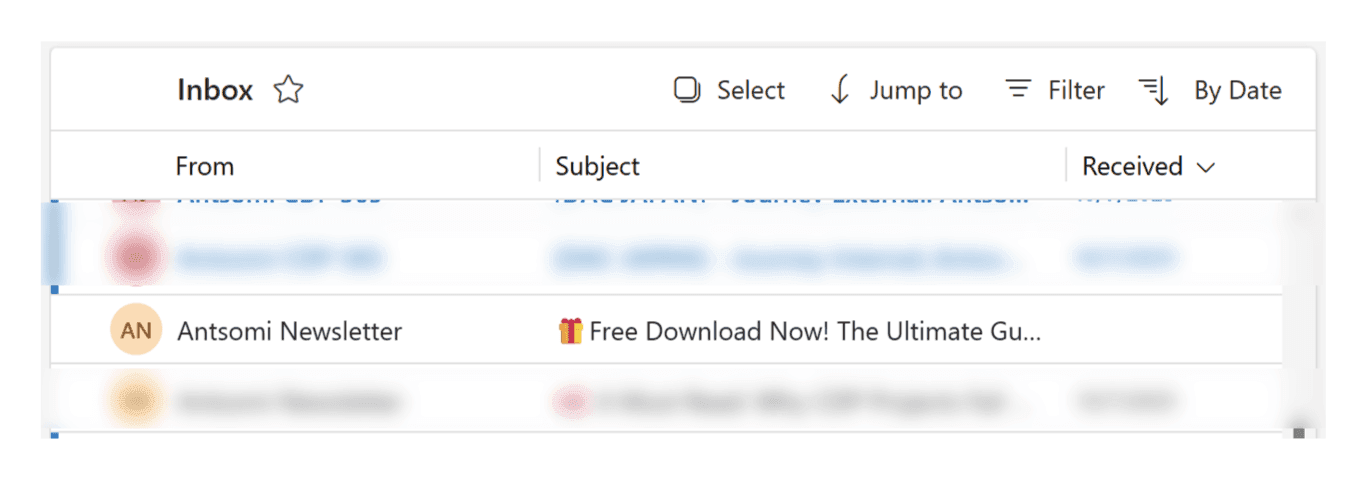
Test 1: Adding Names to Subject Lines (Improving Open Rate)
Hypothesis: By automatically adding the user's name ("Dear [Name],") into the email subject line, they will see it is for them, helping the email stand out and increasing the open rate.
Pattern A (Control)
Standard Subject Line (No personalization)
Pattern B (Variation)
Subject line with dynamic name insertion ("Dear [Name],")
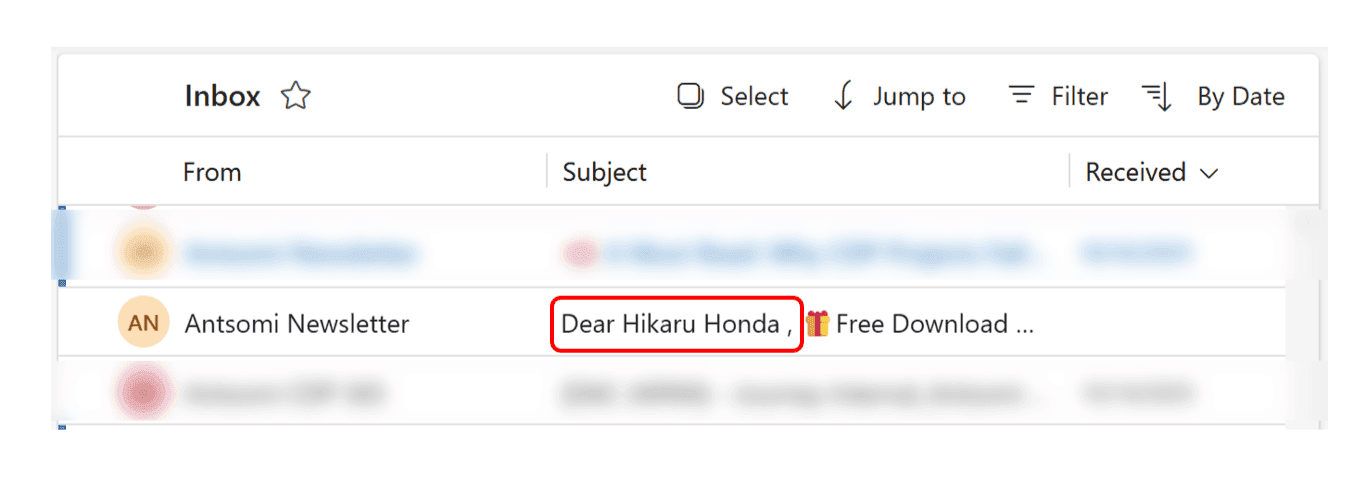
Verdict: "With Name" Wins (Statistically Significant)
Total Sample Size: Approx. 6,000 deliveries (A: 2,982 / B: 3,108)
Data Progression Timeline:
| Period | Emails Sent | Pattern A | Pattern B | Result |
|---|---|---|---|---|
| Month 1 | 4 times | 48% | 51% | No difference yet (Not enough data) |
| Month 2 | 8 times | 47% | 50% | Still waiting for clear proof |
| Month 3 | 12 times | 47.95% | 50.71% | Significant Difference Reached! |
The successful test above was powered by Antsomi CDP 365. Through our comprehensive H+ CDP solution, we help businesses select and implement powerful data platforms like this to achieve true data-driven marketing.
Discover H+ CDP Solutions
Test 2: First View Visuals (Improving Click Rate)
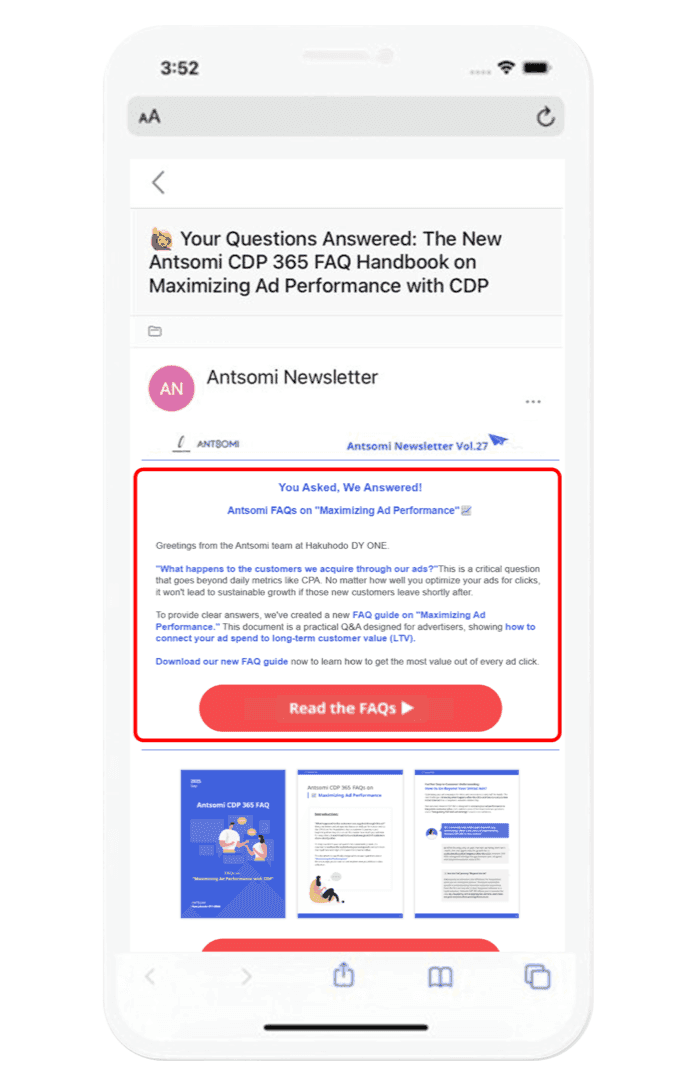
Hypothesis: When users open the email on their phone, showing a clear Banner Image first will grab their attention faster than reading a lot of text, leading to more clicks on the buttons.
Pattern A (Control)
First View: Text Only introduction
Pattern B (Variation)
First View: Visually striking Banner Image
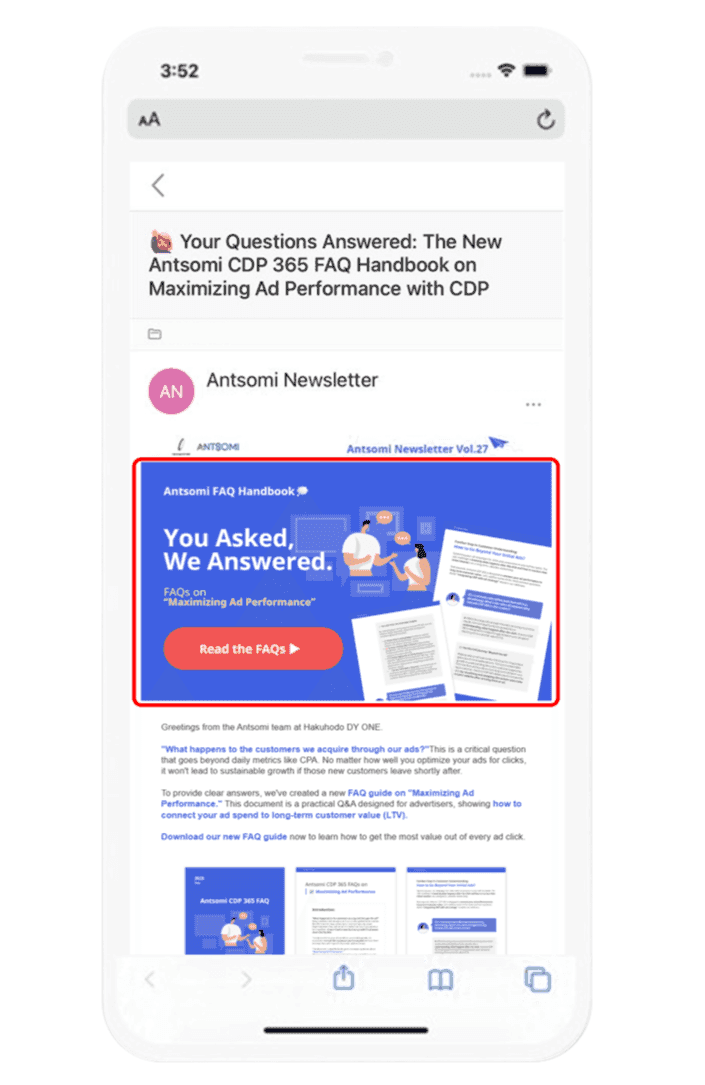
Verdict: "Banner Image" Wins (Statistically Significant)
Total Sample Size: Approx. 3,600 "Opens" (A: 1,821 / B: 1,820)
Data Progression Timeline:
| Period | Emails Sent | Pattern A | Pattern B | Result |
|---|---|---|---|---|
| Month 1 | 4 times | 2.9% | 4.0% | Difference exists, but low confidence |
| Month 2 | 8 times | 2.8% | 4.1% | Almost there |
| Month 3 | 12 times | 2.86% | 4.12% | Significant Difference Reached! |
Unexpected Realities & Lessons Learned
-
⏳
Thinking "It'll be done in a month" was a big mistake: At first, I thought I would have clear results in 30 days. But in reality, it took a full 3 months for both tests to become completely reliable. Why? Because the difference between A and B was small, and the total number of clicks was low. To prove that a small change wasn't just lucky, I had to gather a lot of data over time.
-
🎲
The Trap of "False Hope": I felt a lot of stress seeing Pattern B winning in the first few weeks, only to see Pattern A take the lead the next week. It’s like rolling a dice a few times and thinking "the number 1 comes up a lot." You must stay calm and not get emotional about the numbers when you don't have enough data. Wait until your software tells you it is a "Significant Difference".
-
🏃
Optimization is a Marathon, Not a Sprint: I spent 3 months finding one winner. But that doesn't mean my email results will grow forever. I just improved my base score a little bit. I learned that running just one test is not enough. To keep improving, you need to keep testing: "Guess → Test → Learn → Next Test."
Conclusion
Anyone can start an A/B test today. But getting accurate, useful results requires patience and an understanding of the basics.
Like my early tries, you will hit walls—sometimes the results won't be clear, or you won't have enough traffic. But the real data and user insights you get from a good test are amazing assets that opinions cannot replace.
Why not start today with one minor change, backed by one solid reason?
Have Questions or Want to Learn More?
Contact us for more information about H+ CDP and how it can help your business.
Email us at: antsomi-contact@hakuhodody-one.co.jp
Or, fill out the form below and we'll get back to you shortly.