
AIO Implementation Roadmap: 7 Strategies to Create "Citation-Worthy" Content, Vol2
Published: Nov 25, 2025|9 min read|

Table of Contents
As established in Vol.1, modern search strategy must build upon minimum SEO foundations while moving toward AIO—content that is "cited and recommended" by AI.
This Vol. 2 assumes that minimum SEO (technical foundation, E-E-A-T, basic on-page elements) is in place. We will detail a concrete AIO Implementation Roadmap across seven steps for creating content favored by AI.
Chapter 1: The Core of AI-Preferred Content Design
AI search prefers instantly extractable "atomic units of information (chunks)" rather than entire pages. We redesign content based on this principle.
AI prioritizes efficiency and favors content written "conclusion first".
Segmenting content into logical "chunks" facilitates the AI's extraction process.
Actionable Steps:
- 🔹 Section Independence: Ensure each H2 section is self-contained, making sense even when read in isolation without referring to previous sections.
- 🔹 Structured Format: Definitions, procedures, comparison tables, and statistics must be explicitly structured as bulleted lists, numbered lists, or HTML tables. AI favors structured data (especially comparisons and how-to steps) over prose.
AI tends to build answers based on established facts and brands, prioritizing content containing statistics and data points.
Actionable Steps:
- 🔹 Data Density: Aim to incorporate statistics, percentages, and numerical data consistently throughout the article. Target a ratio of one statistic per 150–200 words.
- 🔹 Citation Clarity: Always cite credible sources for statistics and claims, and ensure they are marked with temporal indicators (freshness).
Schema Markup acts as a "nutrition label" that clearly communicates the content's meaning to AI systems.
Actionable Steps:
- 🔹 JSON-LD Format: Implement schema markup using the JSON-LD format recommended by Google.
- 🔹 Essential AIO Schema: Apply FAQPage schema to FAQ sections and HowTo markup to procedural content. This clarity significantly increases the likelihood of AI understanding and citing your content.
Chapter 2: Essential New Metrics and Leveraging Non-Owned Media
Traditional SEO metrics (rankings, traffic) are insufficient for fully assessing AI search performance. You must track these new AIO metrics:
- 📈 AI Share of Voice:
- 🔹 Definition: The frequency with which your brand is cited or mentioned in LLM results (AI Overview, ChatGPT, Perplexity answers) compared to competitors.
- 🔹 Measurement: Periodically audit AI tools by entering your primary queries and documenting whether your brand name or URL is cited. Tools like Qwairy can automate this.
- 💖 Brand Sentiment Tracking:
- 🔹 Background: LLMs consider sentiment (positive or negative) towards a brand when synthesizing answers. Understanding how AI characterizes your brand is crucial.
- 🔹 Actionable Steps: Monitor what neutral, positive, or negative information AI tools synthesize about your products compared to competitors. If AI spreads misinformation, create authoritative content that directly addresses and corrects those misconceptions.

AI determines authority not just from owned media but from the entire web. It is essential to strengthen brand presence in places LLMs trust and use as citation sources.
Actionable Steps (ASEAN-Relevant Examples):
- 🔹 YouTube (Video Content): AI prefers multimodal data (text, images, video). Provide accurate transcripts and detailed descriptions for YouTube videos, allowing AI to recognize this information as "text chunks" and cite it.
- 🔹 LinkedIn/X (Social Platforms): Build authority by publishing expert insights and opinions on these platforms with a consistent author name and tone. This signals author consistency and expertise (E-E-A-T) to AI.
- 🔹 Guest Posting on Specialized Media: Secure contextually relevant editorial links and brand mentions on authoritative, niche-specific media. AI values mentions in contextually aligned locations more highly than raw link authority from off-topic, high-authority sites.
Chapter 3: Data and AI Integration: Enhancing AIO with CDP
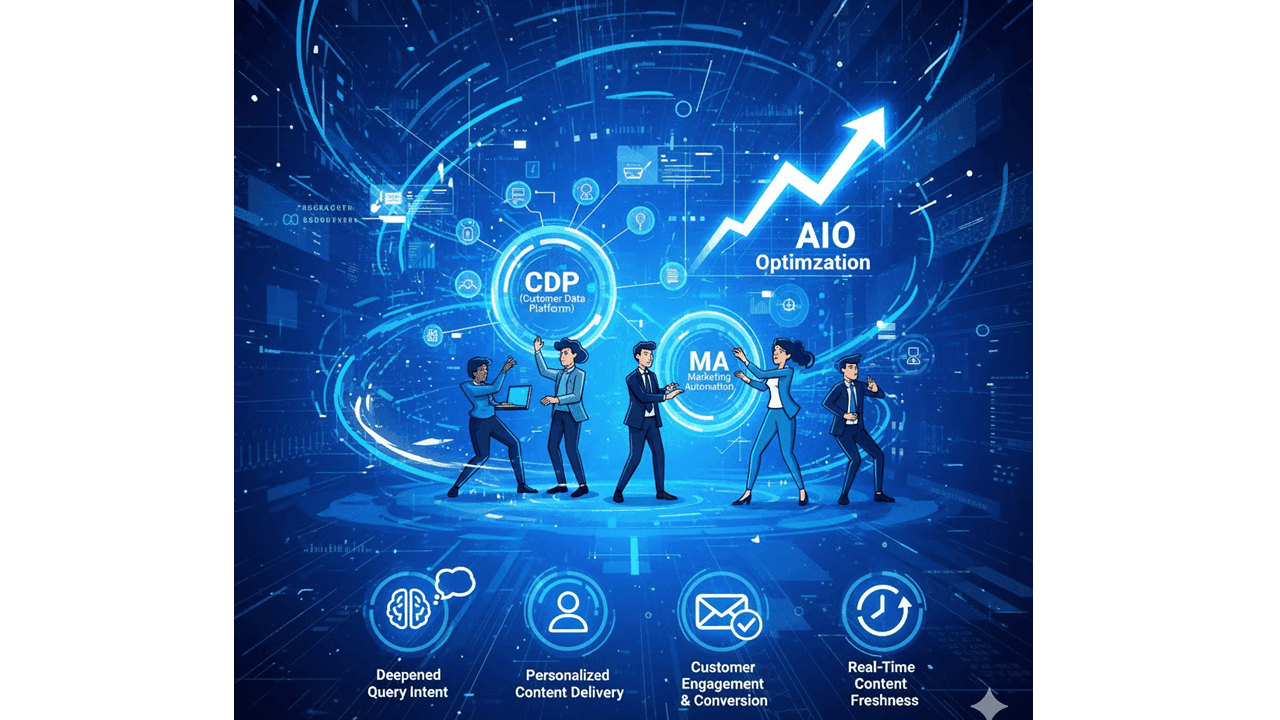
After achieving minimum SEO and executing the structural AIO strategies, the next step is to maximize content relevance and personalization using data. CDP (Customer Data Platform) and MA (Marketing Automation) tools provide the "customer context" that traditional SEO tools lack, significantly boosting your AIO strategy.
Utilizing Antsomi CDP 365 for AIO (Concise Mention):
CDP tools like Antsomi CDP 365 integrate customer data from online (website behavior) and offline (CRM data) sources to provide a unified customer view. This integrated data contributes to your AIO strategy in the following ways:
- 🔹 Deepening Query Intent: CDP data on customer purchase journeys and engagement levels helps identify which topics genuinely have high conversion intent. This allows you to focus content efforts on the sub-queries (transactional fan-outs) that the AI is most likely to generate and that lead directly to transactions, rather than just high-volume searches.
- 🔹 Real-Time Content Freshness: CDP collects real-time customer engagement signals. This insight helps streamline content lifecycle management by identifying content that urgently requires updates (freshness) to meet the AI model's preference for up-to-date information.
Conclusion: AIO Checklist and Continuous Learning
Success in the AI search era requires optimizing technology (SSR/Headless CMS), redesigning content (Answer-First, high Fact Density), and updating measurement metrics (AI Share of Voice). AIO is not a one-time setup but requires continuous monitoring and adjustment.
AIO Implementation Checklist
Implement the following checklist to periodically audit whether your content is ready to be cited by AI.
| No. | Item | Summary |
|---|---|---|
| 1 | Technical AIO Readiness | Is primary content visible to AI crawlers without JavaScript via SSR, SSG, or prerendering? |
| 2 | Answer-First Structure | Does the beginning of each section (40-60 words) concisely state the direct conclusion to the question addressed? |
| 3 | Semantic Chunking | Is content logically segmented, are H2 sections self-contained, and can AI easily extract individual facts? |
| 4 | Structured Data Implementation | Is FAQPage or HowTo schema implemented in JSON-LD format for relevant content? |
| 5 | Fact Density & Authority | Is the content rich in statistics, citations, and expert insights, with clear source attribution? |
| 6 | Humanity Assurance | Does the content include unique case studies, human experience, or emotional storytelling that AI cannot replicate? |
| 7 | Multi-Platform Strategy | Is the brand presence consistent across authoritative non-owned channels like YouTube transcripts and LinkedIn posts? |
| 8 | AIO Measurement Adoption | Are new metrics such as AI Share of Voice and Brand Sentiment Tracking actively monitored? |
Explore the strategic shift from traditional SEO to AIO (Artificial Intelligence Optimization) in the new era of AI-driven search. This article details why SEO alone is insufficient as platforms like Google's AI Overview change user behavior and impact traffic.
Glossary
| Term | English Term | Explanation |
|---|---|---|
| AIO | Artificial Intelligence Optimization | A comprehensive approach to optimize content and digital strategy so that AI systems (LLMs, AI Overviews, etc.) can easily understand, process, and cite them. It aims to maximize AI visibility beyond traditional SEO. |
| GEO | Generative Engine Optimization | A strategy focused on being cited as a source in the generated answers of search engines powered by LLMs (e.g., Google AI Mode, Perplexity). |
| AEO | Answer Engine Optimization | A strategy to structure content for citation in direct answers and snippets generated by AI. |
| LLM | Large Language Model | AI models like ChatGPT and Gemini, trained on massive datasets, that generate synthesized, context-aware answers to queries. |
| Query Fan-Out | Query Fan-Out | An information retrieval technique used by AI search to break down a user's single query into multiple related sub-queries, which are searched simultaneously to cover the user's latent intent. |
| RAG | Retrieval-Augmented Generation | A mechanism where LLMs search external knowledge bases or web content and use that retrieved information to generate grounded answers. |
| E-E-A-T | Experience, Expertise, Authoritativeness, Trustworthiness | Factors prioritized by Google for content quality evaluation. They serve as strong credibility signals for brands cited in AI search. |
| SSR/CSR | Server-Side Rendering / Client-Side Rendering | Methods for rendering web content. SSR generates HTML on the server, while CSR uses JavaScript in the browser. Most AI crawlers cannot see CSR content. |
| AI Share of Voice | AI Share of Voice | A new metric tracking the frequency with which your brand is mentioned or cited in LLM-generated answers compared to competitors. |
| Brand Sentiment | Brand Sentiment | The evaluation of how AI models characterize your brand (positively, negatively, or neutrally). It influences the trustworthiness of the sources cited by AI. |
| Headless CMS | Headless CMS | A system architecture that separates the content management layer from the display layer. It enables the hybrid rendering strategies essential for AIO. |
| Article Title | URL |
|---|---|
| 2026 SEO Trends: Top Predictions from 20 Industry Experts - Moz | https://moz.com/blog/2026-seo-trends-predictions-from-20-experts |
| 7 Powerful Reasons LLMO Is the Future of SEO - Emeralds Media | https://emeraldsmedia.com/what-is-llmo-and-why-does-it-matter/ |
| AIO (AI Optimization) vs Traditional SEO: Which One Should Your Business Focus On? | https://proximatesolutions.com/aio-ai-optimization-vs-traditional-seo-which-one-should-your-business-focus-on/ |
| AIO: The Future of Content Strategy for SEO | ClickRank | https://www.clickrank.ai/integrating-aio-into-modern-content-strategies/ |
| AIO vs SEO: Understanding the Role of All-in-One AI Optimization - Nine Peaks Media | https://ninepeaks.io/aio-vs-seo-understanding-the-role |
| AI Crawlers vs. Traditional Crawlers: How AI Indexes the Web Differently - Avenue Z | https://avenuez.com/blog/ai-crawlers-vs-traditional-crawlers-how-ai-indexes-the-web-differently/ |
| AI-Based Automated Content Generation and its SEO Effectiveness - INNOVATIVE SCIENCE PUBLISHING | https://journals.innoscie.com/index.php/ijnras/article/view/46 |
| Does ChatGPT and AI Crawlers Read JavaScript? What It Means for SEO | https://seo.ai/blog/does-chatgpt-and-ai-crawlers-read-javascript |
| How to Optimize for “Fan out” Queries for AI Optimization - Ann Smarty's Search & #AI Digest | https://www.annsmarty.com/archive |
| SEO vs. GEO, AEO, LLMO: What Marketers Need to Know - Backlinko | https://backlinko.com/seo-vs-geo |
| The Complete AIO Implementation Guide for Business Owners - Single Grain | https://www.singlegrain.com/marketing-101/the-complete-aio-implementation-guide-for-business-owners/ |
| The Definitive Guide to Fine-Tuning LLMs | https://21944583.fs1.hubspotusercontent-na1.net/hubfs/21944583/eBooks/Predibase_Fine-Tuning_LLMs_ebook_.pdf |
| To SSR or not to SSR: The Developer's Guide to Rendering in the Age of AI - Magnolia CMS | https://www.magnolia-cms.com/blog/to-ssr-or-not-to-ssr-the-developer-s-guide-to-rendering-in-the-age-of-ai.html |
| What is Generative Engine Optimization (GEO)? Complete Guide 2025 - Frase.io | httpss://frase.io/blog/what-is-generative-engine-optimization-geo/ |
Have Questions or Want to Learn More?
Contact us for more information about H+ CDP and how it can help your business.
Email us at: antsomi-contact@hakuhodody-one.co.jp
Or, fill out the form below and we'll get back to you shortly.