
AI Search Strategy in the Age of AI: Why SEO Alone Is Insufficient and AIO Is Essential,Vol1
Published: Nov 20, 2025|8 min read|
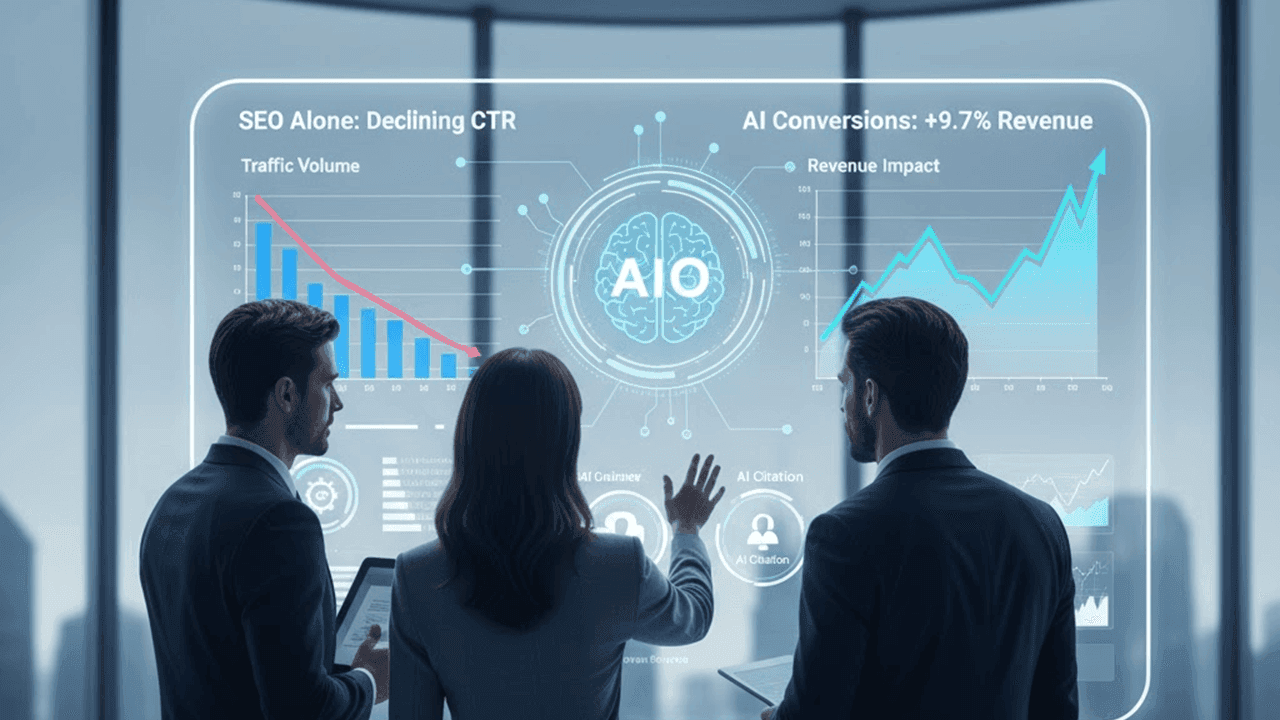
Table of Contents
- Introduction: The Search Paradigm Shift and Marketing Crisis
- Chapter 1: AIO is Not a Luxury; It's an Essential Strategy Beyond "Minimum SEO"
- Chapter 2: The Critical Technical Barrier in the AIO Era: JavaScript Rendering
- Chapter 3: AI Era Content Strategy: Query Fan-Out and the Importance of Humanity
- Conclusion: The Transition to AIO Strategy Must Begin Now
- Glossary
- References
- Contact Us / Ask a Question
Introduction: The Search Paradigm Shift and Marketing Crisis
The Era of Digital Marketing’s “Blue Links” is Over
For decades, the goal of digital marketing was simple: rank high on Google's Search Engine Results Pages (SERP) and drive users to your website. This was a battle to get users to click on standard organic search results (once known as "blue links").
However, in 2025, the very mechanism of search has fundamentally changed. With the evolution of Large Language Models (LLMs), AI platforms like Google’s AI Overview, ChatGPT, and Perplexity synthesize information from across the web to provide direct, generated answers to complex user queries.
The Facts of 2025: Traffic Decline and Revenue Impact
This "answer-first" AI search environment is dramatically lowering Click-Through Rates (CTR) to websites.
- Google’s AI Overview now appears in over 13% of Google searches and captures an average of 15.49% of organic clicks.
- One study showed that while AI platforms drove less than 1% of traffic, the conversions generated through these AI searches contributed 9.7% of the total revenue for B2B companies.
The new discipline born to ensure brand visibility in this environment is AIO (Artificial Intelligence Optimization).
Chapter 1: AIO is Not a Luxury; It's an Essential Strategy Beyond "Minimum SEO"
Before discussing AIO, a major prerequisite must be established: AIO does not replace traditional SEO; it builds upon it. If the foundation of SEO is weak, AIO efforts will be ineffective.
The Foundation of AIO: Minimum SEO Checklist to Achieve
To be cited by AI, your content must first be "discovered" and "understood" by search engines and AI crawlers. The checklist below outlines the "Minimum SEO" elements your brand must achieve before embarking on AIO.

What is AIO: The Decisive Difference from SEO
If "Minimum SEO" is the foundation for website visibility, AIO (or GEO/AEO/LLMO) is the strategy for getting cited in the AI search era.
Chapter 2: The Critical Technical Barrier in the AIO Era: JavaScript Rendering
The biggest technical barrier to AIO success is JavaScript rendering.
The AI Crawler’s "Blind Spot"
Client-Side Rendering (CSR), which generates website content dynamically using JavaScript, improves user experience but poses a significant problem for AI crawlers.
- Googlebot has evolved to execute JavaScript using a Headless Chromium browser, allowing it to render and index dynamic content (SPAs like React, Vue). This is why Google's AI Overview can summarize JS-rich sites.
- However, most AI crawlers (GPTBot, ClaudeBot, PerplexityBot, Meta-ExternalAgent, ByteDance, etc.) currently do not execute JavaScript.
When these AI crawlers visit a site, they only see the "raw" HTML (the initial server response). If your product listings, pricing, or vital content are loaded after JavaScript execution, AI crawlers see only an empty shell, rendering that information invisible.
Consequently, your most critical content risks being excluded from AI assistant product recommendations or summaries.
💡The Solution: Adopting Headless CMS and Optimizing Rendering Strategy
To solve this technical challenge in the AI era, you must adopt a strategy that renders content on the server side.
Server-Side Rendering (SSR) and Static Site Generation (SSG):
- SSR renders the complete HTML page on the server for each request. This is ideal for dynamic content like e-commerce product pages with frequently changing prices or news sites, ensuring AI crawlers always receive the latest information.
- SSG pre-renders all pages into static HTML files at build time. It offers excellent performance and SEO but is unsuitable for real-time data.
Adopting these technologies (achievable with modern frameworks like Next.js) ensures AI crawlers can read the entire content from the initial request.
Leveraging Headless CMS:
Adopting a Headless CMS completely separates the content management backend from the presentation layer (frontend).
This separation allows for a Hybrid Rendering Strategy, where SSR, SSG, or CSR can be mixed and matched based on the specific characteristics of each page or component.
For example, you can use SSG for fast, static homepages, CSR for dynamic cart/checkout pages, and ISR (Incremental Static Regeneration) for frequently updated blog articles. This page-specific optimization meets AIO's technical requirements while maintaining the best user experience.
Prerendering:
If immediate rebuilding of a JavaScript-heavy site is not feasible, services like Prerender.io can intercept crawler requests and serve static HTML snapshots.
Discover how Headless CMS solves monolithic CMS bottlenecks in performance, SEO, and development. Learn decoupling strategies, API-first architecture, rendering options (SSG/SSR/ISR), and practical optimization steps to boost Core Web Vitals and search rankings.
Chapter 3: AI Era Content Strategy: Query Fan-Out and the Importance of Humanity
The Mental Shift: From Keywords to Journeys (Query Fan-Out)
The biggest conceptual shift in AI search content strategy is driven by the technology known as Query Fan-Out.
Background and Definition:
Traditional search focused on matching user input keywords exactly to terms in the database. However, when users submit complex natural language queries in AI search (like Google's AI Mode), the system cannot rely solely on simple keyword matching.
How Query Fan-Out Works:
AI Mode uses an information retrieval technique (Fan-Out) that breaks down a single input query into a multitude of related sub-queries simultaneously, capturing the user's underlying intent and relevant subtopics. It then searches for information to answer all these sub-queries in parallel.
Analogy:
If a user asks, "What is the best training plan for a beginner to finish a half marathon," the AI breaks this down into 15–20 specific questions (sub-queries), such as "16-week beginner half marathon plan," "stretch routines for runners," and "half marathon gear checklist," searching for optimal information for each.
New Content Requirements
To address Query Fan-Out, content must meet the following new requirements:
- Comprehensive Journey Coverage: Instead of optimizing for single keyword rankings, build "intent-complete hubs" that exhaustively cover a topic and preemptively answer the user's next logical questions (latent intent).
- Extractability Optimization: When synthesizing an answer, AI extracts specific "atomic units of information" (definitions, lists, steps) rather than the entire page. Therefore, content must be structured using headings, lists, and schema markup so that it can stand alone when lifted out of context.

Defeating Mass-Produced AI Content with "Humanity"
While AI technology offers the ability to mass-produce keyword-optimized content (scalability), the web is also being saturated by low-value, AI-generated content, forcing search engines to deprioritize the crawling and indexing of low-value pages.
The difference between AI-generated content and content imbued with human expertise and originality lies in its quality and durability of engagement.
The Challenge of AI Content:
AI can generate grammatically correct text but often struggles to replicate human emotion, humor, empathy, or a unique, personal perspective. Consequently, even if AI-generated content ranks temporarily well, user engagement metrics (dwell time, bounce rate) suffer, leading to a lower conversion rate (one study showed 5.2% for AI-generated vs. 9.8% for human-written content).
Human Expertise and Originality:
Storytelling that encourages readers to "teach back" the ideas makes content memorable, shareable, and citation-worthy. To escape the sea of mass-produced AI content, it is crucial to incorporate real human experience and unique, data-backed insights.

Conclusion: The Transition to AIO Strategy Must Begin Now
The shift to AIO is not just an SEO update but a strategic transformation that redefines content creation, technology stacks, and organizational goals.
In this Vol. 1, we established the technical foundation (SSR/Headless CMS) and the strategic shift (Query Fan-Out) necessary to survive the AI search era. In the upcoming Vol. 2, we will provide a detailed "AIO Implementation Roadmap" in a checklist format to put this strategy into action.
Move beyond traditional SEO. This guide provides a 7-step AIO implementation roadmap to ensure your content is understood, prioritized, and cited by AI.
Glossary
References
Have Questions or Want to Learn More?
Contact us for more information about H+ CDP and how it can help your business.
Email us at: antsomi-contact@hakuhodody-one.co.jp
Or, fill out the form below and we'll get back to you shortly.