
Case Study: Super-Fast B2B Sites and AI-Era SEO Strategy Achieved with Headless CMS
Published: Nov 11, 2025|10 min read|
Table of Contents
- Introduction: The Era of Digital Competition Demands the Best "Hospitality"
- Chapter 1: Headless CMS Overview: Separating the Kitchen and the Dining Area
- Chapter 2: H+ Site Architecture: The Secret to High Scores
- Chapter 3: Towards a Partnership to Create the Future Together
- Terminology (Glossary of Technical Terms)
- Contact Us / Ask a Question
Introduction: The Era of Digital Competition Demands the Best "Hospitality"
In modern B2B marketing, to capture the hearts of potential customers, it's crucial not just what information is provided, but how quickly, seamlessly, and personally it is delivered. Slow-loading websites or inconsistent information experiences across different designs and devices erode customer trust and engagement.
Many companies striving for digital transformation (DX) face structural challenges such as "inability to fully utilize implemented tools," "data fragmentation across departments (siloed data)," and "legacy systems that cannot respond quickly to market changes."
At H+(H Plus), to propose truly effective solutions to our clients, we practice the latest technologies in our daily work, based on our unwavering belief that "we must try it ourselves before recommending it to clients."
The new information dissemination site, https://cdp.hplus.digital, which we have just launched at the end of September 2025, was developed as a "showcase" of our practices and expertise.
This site is a "living laboratory" designed to demonstrate the effectiveness of the cutting-edge marketing solutions we offer to our clients, by fully utilizing them ourselves in the field of B2B marketing. In particular, it is centered around Antsomi CDP365 (Customer Data Platform), which integrates and analyzes first-party data such as site visitor behavior and seminar participation history, allowing us to implement a true data-driven strategy.
This white paper uses the easy-to-understand analogy of "restaurant operations" for non-experts to explain how this "laboratory" achieves overwhelming performance and flexibility, revealing the secrets of its latest architecture, especially the strategic use of Headless CMS and Next.js.
Collect Data
Website & All Channels
Unify & Analyze
360° Customer View
Drive Revenue
Sustainable Growth
Chapter 1: Headless CMS Overview: Separating the Kitchen and the Dining Area
Content Management Systems (CMS) are broadly categorized into two types: traditional (monolithic CMS) and Headless CMS. The difference between them can be easily understood using the analogy of a restaurant's structure.
🏢 [Analogy: Integrated Restaurant (Traditional CMS)]
Traditional CMS is an integrated system where content management functions (backend/kitchen) and user display functions (frontend/dining area) are tightly coupled (monolithic CMS).
Challenges:
- If you try to renovate the kitchen (content management) (system update), it affects the dining area (design and display), requiring a large-scale reconstruction.
- Furthermore, when trying to deliver dishes (content) through new channels other than the dining area (website), such as takeout (mobile app) or delivery (IoT devices), the entire system needs to be modified, leading to low flexibility.
🚚 [Analogy: Separated Logistics (Headless CMS)]
Headless CMS completely separates (decouples) content management and storage functions (kitchen) from content display functions (dining area).
The CMS purely acts as a "logistics center" that manages "content (food recipes and ingredients)" as structured data, without design functions for display (the "head").
This content data is delivered to external display systems (dining area/frontend) via an API (Application Programming Interface), which acts as a "digital order window."
This "separation of kitchen and dining area" offers decisive advantages, especially in strengthening the B2B marketing foundation:

⚡ Overwhelming Speed and SEO Superiority
By adopting lightweight, high-speed modern technologies like Next.js for the frontend, page load times and responsiveness (Core Web Vitals) dramatically improve, leading to a superior position in Google's search rankings.
📱 Realization of Omnichannel Delivery
Since content is freed from specific designs and managed centrally as data, a "create once, publish anywhere" strategy (Content Reusability) becomes possible. Consistent content can be delivered across all channels, including websites, mobile apps, digital signage, and IoT devices.
🔧 Development Flexibility and Future-Proofing
Developers are not constrained by PHP or specific themes and can freely choose optimal, modern frameworks like Next.js and React. Even if new technologies or devices emerge in the future, it's a "future-oriented architecture" that allows adaptation by updating only the frontend without significantly changing the content infrastructure.
🔒 Improved Security
Since the content management layer (backend) is separated from the display layer (frontend) directly exposed to users, the attack surface for cyberattacks is reduced.
📈 High Scalability
The backend and frontend can be scaled independently in response to increased content volume or traffic, enabling flexible to high-traffic B2B sites and global expansion.
⏱️ Improved Development and Operational Efficiency
Development teams and content creation teams can work independently and in parallel, accelerating content release cycles and shortening the time-to-market.
Chapter 2: H+ Site Architecture: The Secret to High Scores
Our information dissemination site achieves outstanding performance and stability by combining Headless CMS (content layer) and Next.js (frontend layer), creating the "best kitchen and best dining area."

💎 Built with Next.js + Headless CMS
Next.js is a full-stack framework based on React that provides hybrid rendering functions (SSR, SSG, ISR) necessary for website acceleration and SEO optimization. With this combination, Headless CMS supplies lightweight content data (ingredients and recipes), and Next.js delivers that data in the fastest and most optimized form (the best dish) to users.
🤖 Built with Full AI Coding using Gemini CODE ASSIST
In the construction process of this site, to demonstrate the future of development efficiency, we partially adopted full AI coding using Gemini CODE ASSIST. This is our unique initiative to show that a rapid and high-quality digital foundation can be built by combining the latest frameworks with AI technology.
🇻🇳 Developed by: DAC Data Technology Vietnam
The development of this site was handled by our group company, DAC Data Technology Vietnam (https://dac-datatech.vn/about-us/).
Based in Hanoi and Da Nang, Vietnam, the company provides consulting and development services for a wide range of technology products in the digital advertising (Ad-Tech) field with an experienced engineering team. DAC Data Technology Vietnam functions as a development hub to enhance technological capabilities as part of the Hakuhodo DY One Group's efforts to strengthen its Southeast Asian business.
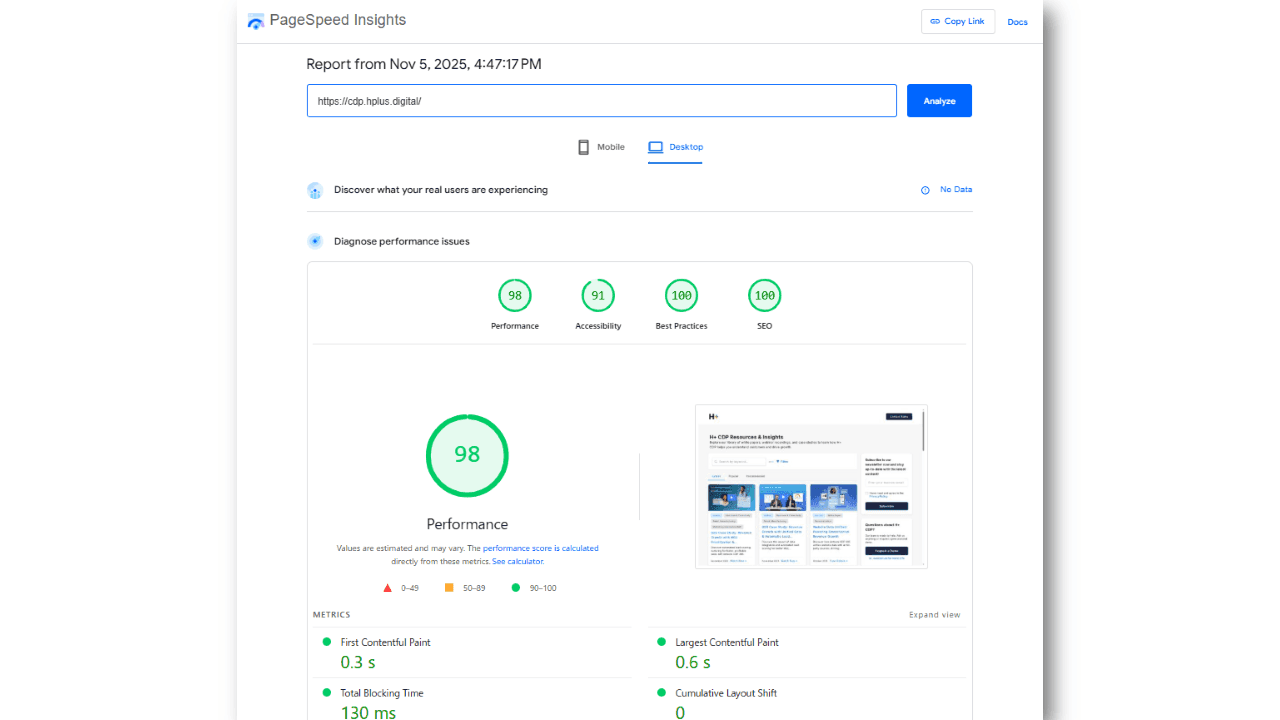
Google's Lighthouse score is an objective indicator of a website's technical quality. It serves as an "opening audit check" for a website, indicating the "audit points" that reflect the level of infrastructure development.
Our site has achieved extremely high standards, as shown below:
(Desktop)
98
Performance
91
Accessibility
100
Best Practices
100
SEO
(Mobile)
66
Performance
91
Accessibility
100
Best Practices
100
SEO

Particularly noteworthy are the values for key indicators of display speed and responsiveness (Core Web Vitals). These figures prove that the best user experience (UX) is realized, where pages load instantly upon user click and can be operated without stress, directly leading to reduced bounce rates and improved SEO rankings.
This astonishing speed is supported by advanced caching strategies and infrastructure.

🌐 Application of Cloudflare CDN
The site's static files and cached content are delivered via Cloudflare CDN (Content Delivery Network).
[Analogy: Global Logistics Network]
A CDN temporarily stores (caches) content on multiple servers (edge servers) distributed worldwide and delivers content from the physically closest server in response to user requests. This reduces the load on the central server (origin server) while achieving ultra-fast and stable delivery on a global scale.
🔄 Strategic Use of ISR (Incremental Static Regeneration)
This site strategically utilizes ISR (Incremental Static Regeneration), a powerful feature of Next.js.
What is ISR: It is a hybrid rendering strategy that efficiently maintains content freshness while preserving the benefits of ultra-fast initial display of Static Site Generation (SSG).
[Analogy: Smart Shelf Auto-Replenishment System]
ISR is a system that, in a library or dining area (website) with many shelves (pages), automatically replenishes only the necessary shelves in the background without having to close (rebuild) the entire facility.
stale-while-revalidate strategy: This is the core concept of ISR. Even if a request comes after a set time (revalidate) has passed, the user is instantly provided with old cached content (Stale Content) while new page regeneration begins in the background. This ensures that users always receive a fast response from the cache.
This feature allows even large-scale B2B media and product pages with relatively high content update frequency to continuously provide up-to-date information without sacrificing performance.
We plan continuous improvements to maintain and further enhance this excellent performance. These are essential elements for optimizing Core Web Vitals (such as LCP and CLS), which Google emphasizes.
📱 Image Optimization for Mobile View:
Next.js provides built-in features (<Image> component) that automatically adjust image sizes and support lazy loading. We will further optimize for mobile users by leveraging this functionality.
🖼️ Support for Next-Generation Image Formats like WebP:
WebP is an image format developed by Google that can reduce file sizes compared to common JPEG images, helping to speed up web page loading (LCP: Largest Contentful Paint). WebP can compress images approximately 26% smaller than PNG and 25-34% smaller than JPEG, and also supports transparency and animation.
By using Next.js's image optimization features, images are automatically converted to WebP format, further improving display speed. Furthermore, beyond WebP, there is a new image format called AVIF (AV1 Image File Format).
AVIF (AV1 Image File Format): AVIF is a new image format based on the open technology "AV1." It can make images very small with extremely high compression rates while maintaining high quality. It is said to reduce file sizes by up to 50% compared to JPEG and about 30% compared to WebP. It supports HDR (High Dynamic Range), transparency, and animation, and is free for anyone to use. It is currently widely used in major browsers such as Chrome, Firefox, Opera, and Edge.
By effectively using these new image formats, web page display speed can be significantly improved, allowing users to use the site more comfortably. Next.js's image optimization features also leverage these formats to automatically deliver images in the optimal format for the browser and device being used, aiming for the best performance.
Chapter 3: Towards a Partnership to Create the Future Together
As introduced in this white paper, an architecture combining Headless CMS and Next.js is the foundation for building future-oriented digital assets with speed, flexible scalability, and ultimate SEO control.
Now, for advertisers, is your website's "dining area" comfortable for your customers?
If your site is built with a traditional monolithic CMS and you are facing the following challenges, you may be fatally lagging behind in digital competitiveness:
- Slow display speed, failing to meet Google's Lighthouse scores and Core Web Vitals criteria.
- Content deployment to mobile apps and new devices is complex and inefficient.
- Security and scalability issues make it difficult to add new designs or features.
When the technical foundation (technical SEO) is solidly in place with Headless CMS, and the "opening audit (Lighthouse score)" passes, the resources should be concentrated on "content quality and comprehensiveness," i.e., strengthening E-E-A-T (Experience, Expertise, Authoritativeness, Trustworthiness).
In an era where AI-generated search results (AI Overview) are expanding, the importance of structured data (Schema Markup) that accurately conveys the meaning of content to search engines and AI is dramatically increasing. Headless CMS manages content as structured data, making it possible to incorporate this essential technical element for the AI search era from the design stage.
Based on our belief that "we cannot recommend tools to clients that we don't even use ourselves," we combine the concrete know-how cultivated in this "living laboratory" with the latest technological capabilities of DAC Data Technology Vietnam's engineering team to contribute to our clients' digital asset construction.
H+(H Plus) will walk alongside your business to achieve new success with the power of the best technology foundation and data strategy.
Please feel free to contact us for a consultation.
Terminology (Glossary of Technical Terms)
Have Questions or Want to Learn More?
Contact us for more information about H+ CDP and how it can help your business.
Email us at: antsomi-contact@hakuhodody-one.co.jp
Or, fill out the form below and we'll get back to you shortly.