
From Conversation to Action: How AI Agents Are Opening New Horizons in Marketing
Published: Feb 19, 2026|6 min read|
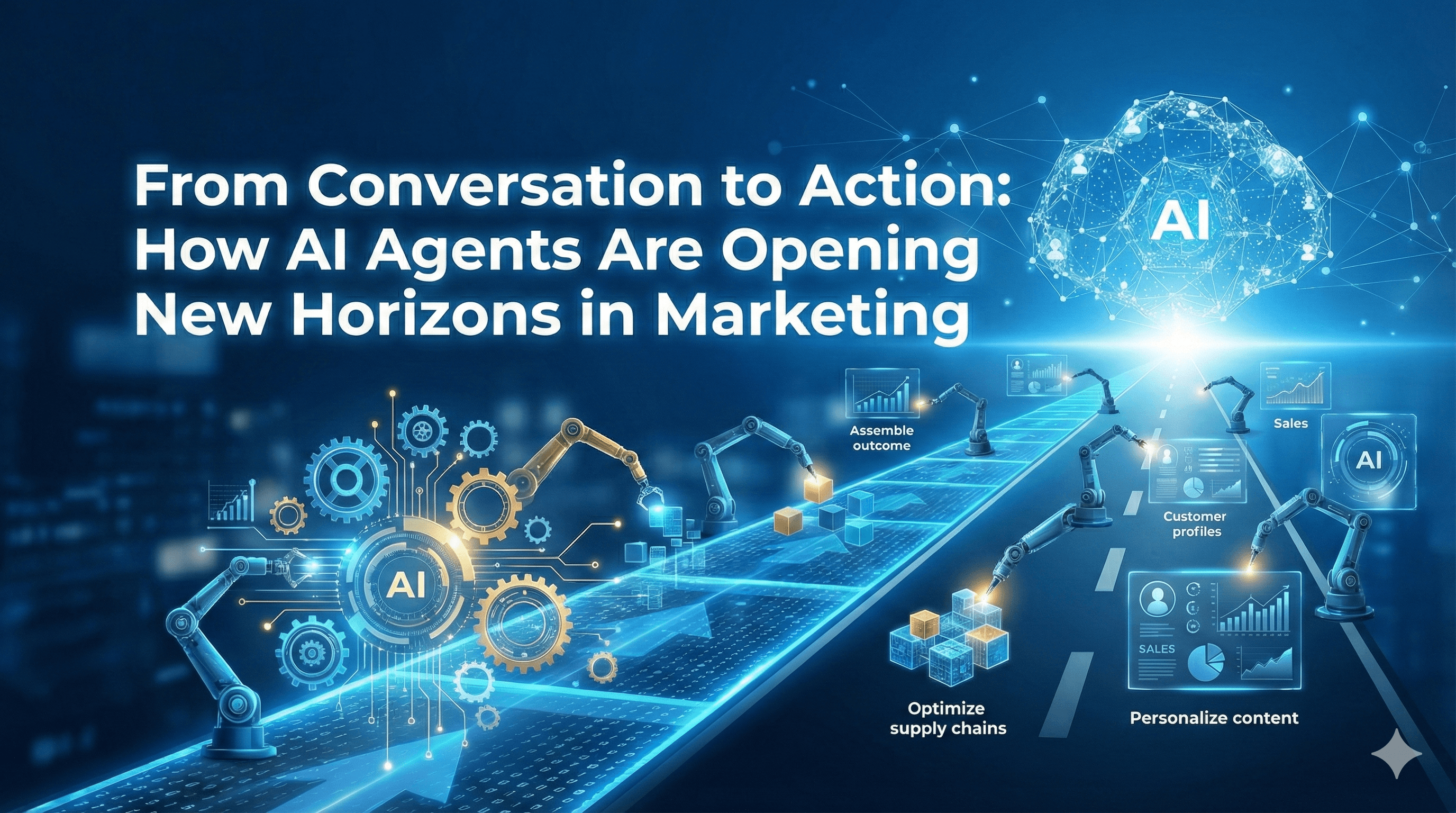
Table of Contents
- Introduction: The End of Frustrating Robots and the Dawn of New Dialogue
- Chapter 1: The Paradigm Shift — From "Scripts" to "Context"
- Chapter 2: Evolution from "Static" to "Dynamic" in Marketing
- Chapter 3: Future Outlook — From "Chatbot" to "Autonomous Agent"
- Conclusion: The Source of Competitive Advantage Lies in "Collaboration with AI"
- Contact Us / Ask a Question
Introduction: The End of Frustrating Robots and the Dawn of New Dialogue
Once, the chatbot in the bottom right corner of a corporate website was a symbol of customer frustration. It accepted only "Yes" or "No," and any question deviating even slightly from the script resulted in a repetitive "I don't understand." It was like a rigid gatekeeper with no flexibility.
However, in 2026, the landscape has completely changed. We are no longer facing simple "automated response programs." We are witnessing the rise of AI Agents that read context, understand emotions, and, most importantly, "act autonomously." This is nothing short of an Industrial Revolution in Customer Experience (CX).
This white paper unravels the evolutionary trajectory from past rule-based chatbots to current Generative AI, and onto future "Agentic AI." Specifically within the marketing domain, we will reveal how this technology has transformed from a "cost-cutting tool" into a "revenue-generating engine," supported by objective data and case studies.
Chapter 1: The Paradigm Shift — From "Scripts" to "Context"
1.1 Limitations and "Negative Legacy" of Rule-Based Systems
Until a few years ago, mainstream "rule-based chatbots" relied on pre-designed decision trees. This is akin to a train on a fixed track. As long as it stays on the rails, it runs smoothly, but if a customer "derails" (asks an unexpected question) even once, the system halts. Implementing this system required immense effort in "organizing Q&As" and "designing scenarios." Despite this, its lack of flexibility often became a factor in lowering customer satisfaction.
1.2 The Breakthrough with Generative AI
The advent of Large Language Models (LLMs) and Retrieval-Augmented Generation (RAG) technology has dramatically shifted the paradigm.
- · Before: When a customer typed "return," the bot would simply present a URL to the return policy.
- · After: In response to a natural query like, "The shoes I bought last week don't fit, what should I do?", the AI references the customer's purchase history and proposes, "Mr./Ms. [Name], referring to the sneakers you purchased: I've checked our inventory and we have one size up available. Shall I proceed with the exchange process right now?"
1.3 Overwhelming Numerical Impact
This evolution is not just about convenience; it is a transformation directly linked to business figures.
- · Improved Resolution: AI can now resolve (Containment Rate) over 80% of routine queries without human intervention, which was difficult for traditional bots.
- · Cost Reduction: Implementing AI chatbots has reduced customer support costs by up to 30%, drastically lowering the cost per service request.
- · Implementation Speed: Processes that used to take over six months now complete in weeks or even days, simply by having the AI ingest existing manuals and documents.
AI has evolved from something "humans must teach" into a reliable new employee that "reads and understands documents on its own."
Chapter 2: Evolution from "Static" to "Dynamic" in Marketing
In marketing, the evolution of AI chat is even more disruptive. It is changing roles from a traditional "Reactive" stance to a "Proactive" one, where the AI initiates engagement with customers.
2.1 The Explosive Spread of "Conversational Commerce"
83% of consumers want to browse and buy products within messaging apps. AI chatbots have evolved from mere website guides into skilled sales associates. For example, at one apparel company, AI functions as a "Virtual Stylist." By analyzing customer preferences, past purchase history, and current trends, it proposes optimal coordinates. Cases have been reported where this personalization caused conversion rates to jump 4x and customer retention to double.
2.2 As a Source of Zero-Party Data
With third-party data usage restricted by cookie regulations, what companies desperately want is "customer insight." Conversations with AI chat are a treasure trove of "zero-party data," where customers voluntarily speak about their preferences and needs. Specific contexts like "I'm looking for a dress for a wedding next month" or "Budget is under $300" can never be obtained from click logs. AI integrates this data into CRM (Customer Relationship Management) systems in real-time to refine subsequent marketing initiatives.
2.3 Top Salesperson Working 24/7
In a case study of a major global fintech company, an AI assistant handled 2.3 million inquiries, reducing resolution time by 80% and driving an estimated $40 million in annual profit improvement. This proves that AI is not just a support role but a business driver directly linked to revenue.
Chapter 3: Future Outlook — From "Chatbot" to "Autonomous Agent"
Now, we are stepping into a new phase called "Agentic AI."
3.1 From "Speaking" to "Executing"
Traditional AI chat's main role was "presenting information." However, future AI agents will reason, plan, and execute using tools.
- · Scenario: "Arranging a business trip for next week."
- · AI Agent Actions:
- o Checks calendar to understand availability.
- o Searches real-time availability for flights and hotels.
- o Selects candidates based on company policy and personal preferences.
- o Automatically executes the approval application flow to superiors.
- o Upon booking completion, registers it in the calendar and sends the itinerary via chat.
The true value of an agent lies in its ability to cross multiple applications and databases to complete complex workflows. Gartner predicts that by 2028, 90% of B2B buying activities will be intermediated by AI agents.
3.2 The Pinnacle of Hyper-Personalization
AI will become a "Personal Concierge" for every customer. By integrating information from every touchpoint—website browsing history, chat comments, purchase data—it proactively provides the information customers want, the moment they want it.
For instance, if a customer leaves items in a cart, the AI doesn't just send a reminder. It delivers a message with context that stimulates purchasing desire at the optimal time, such as "Inventory is running low," or "Accessories matching this item have just arrived."
Conclusion: The Source of Competitive Advantage Lies in "Collaboration with AI"
The evolution of AI chatbots has fundamentally redefined the relationship between companies and customers. It is not inorganic automation, but the realization of "Hospitality" through technology.
- · Past: Rigid responses bound by rules.
- · Present: Context-aware, personalized dialogue.
- · Future: Agents acting autonomously to achieve goals.
For advertisers, introducing AI chat is no longer an "option" but a "requirement." However, the key is not merely installing a tool. It is welcoming AI as a "talented digital employee" to the team and creating an environment where humans can focus on creative strategies. AI handles routine work and data analysis, while humans handle emotional empathy and high-level decision-making. This "Hybrid Intelligence" will undoubtedly be the strongest strategy to win in the business of the next era.
Have Questions or Want to Learn More?
Contact us for more information about H+ CDP and how it can help your business.
Email us at: antsomi-contact@hakuhodody-one.co.jp
Or, fill out the form below and we'll get back to you shortly.