
AI Agents: Autonomous Marketing, Vol.1 – AdCP: AI's Creative Language
Published: Apr 13, 2026|4 min read|
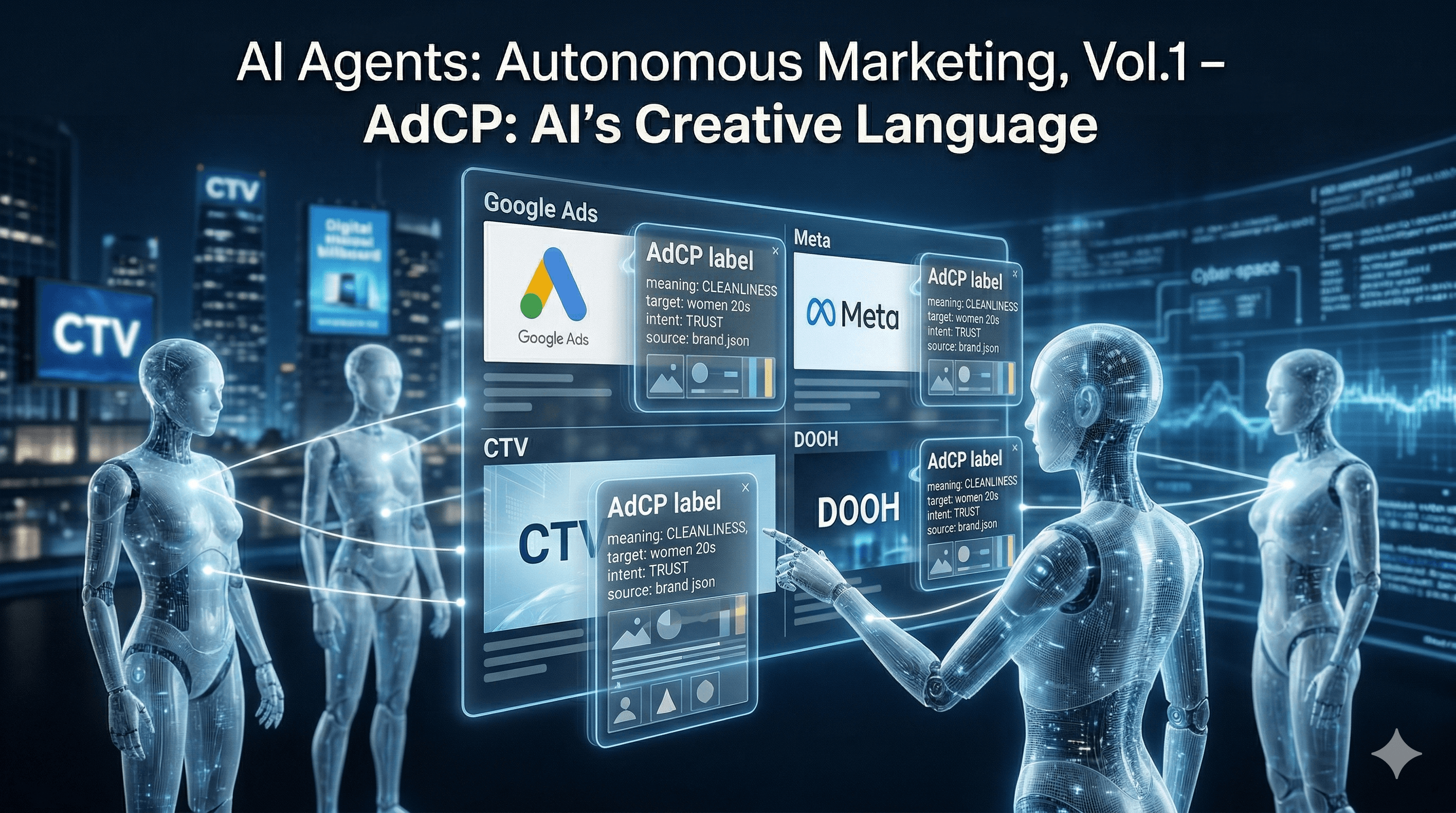
Introduction: Ad Operations in a "Tower of Babel" State
Imagine the scene. At the desks of modern advertising agencies, marketers are exhausted, logging into multiple disparate dashboards day in and day out. From Google and Meta to Connected TV (CTV) and digital out-of-home advertising, each medium possesses entirely different languages and specifications. Human beings are trapped in a modern-day "Tower of Babel," incessantly performing copy-and-paste and adjustment tasks as mere "translators" between incompatible systems.
One might assume the solution is to simply delegate this to AI Agents. An AI Agent is an AI program capable of autonomously assessing situations and acting to achieve goals. However, AI Agents inevitably hit a wall here as well. Because cross-platform specifications are fundamentally fragmented, AI cannot accurately comprehend "what is written" (the true meaning of the data). When systems cannot speak the same language, even the smartest AI reaches an insurmountable ceiling in advanced automation.
What the advertising industry desperately requires right now is the birth of a "standard language" that AI agents can utilize to communicate seamlessly with one another across different platforms.
Chapter 1: AdCP 3.0 as a "Magical Ingredient Label"
Emerging as the savior in this landscape is AdCP (Ad Context Protocol, that is to say, "a common set of rules for AI to exchange the background and context of advertising").
Let us clarify the timeline here. This new protocol saw its first version 2.0 announced on October 15, 2025. Currently, as of April 2026, the highly evolved "AdCP 3.0," the latest standard protocol enabling AIs to commonly understand the "meaning" and "intent" of advertising creatives, is in its final testing stage (Release Candidate).
Standardization through Metadata
Let us compare the function of AdCP to a "food ingredient label" at a supermarket. Under legacy systems, advertising data was perceived by AI as merely a generic piece of "meat" as text information. However, once the magical AdCP label is affixed, it instantly conveys highly specific details—such as "This is an A5-rank sirloin from Hokkaido, optimally prepared with a quick sear"—in a manner that any AI agent can immediately decipher.
From a technical perspective, this signifies the industry-wide standardization of metadata (in other words, "descriptive tags that explain the nature and contents of the data"), which acts as the exact "nutrients" and criteria AI Agents require to make intelligent decisions. Consequently, AI across all platforms can now evaluate and negotiate the value and meaning of advertising based on a universal standard.
Chapter 2: Evolution to 3.0 — AI Capable of Deciphering "Meaning" and "Intent"
The latest iteration, "AdCP 3.0," currently undergoing testing, will revolutionize the realm of advertising creatives even further. Up to version 2.0, AdCP functioned more akin to simple informational tagging. Version 3.0, however, is capable of interpreting human "intent."
Deciphering Contextual Clues
For instance, when evaluating a banner image, legacy AI could only comprehend the physical fact: "This image is blue." However, AdCP 3.0 introduces mechanisms such as brand.json (a system defining brand identity) and visual_guidelines included within it. This enables the AI to interpret the marketer's underlying signal (that is to say, "the production intent or contextual clues regarding how a specific target audience should feel"): "This banner utilizes blue to convey a sense of cleanliness tailored for women in their twenties".
The impact of this capability is profound. During a live campaign, an AI Agent can analyze user reactions in real-time and autonomously deduce, "For this specific target demographic, immediately swapping in this blue banner—crafted with the intent of cleanliness—is the optimal strategy," thereby executing creative optimization entirely without human intervention.
Chapter 3: The Dawn of Creative Democratization and Auto-Optimization
The near future, when this AdCP 3.0 infrastructure stabilizes and becomes widely adopted by publishers and agencies, is projected to arrive between late 2026 and 2027.
In that near-future scenario, the atmosphere of exhaustion will have vanished from the agency desk. In early pilot tests, campaign setup times have already been slashed by 87%. Humans will be completely liberated from the monotonous labor of formatting and translation. Marketers can now dedicate 100% of their passion to their true calling: high-level strategy and the cultivation of creative ideas.
The "common language" (AdCP) for AI Agents is being established, allowing the precise transmission of advertising intent. However, to securely transport this highly sophisticated information across the internet, a robust "passport" is required. In our next installment, we will uncover the secrets of the standard designed to safely carry this information: UCP (User Context Protocol / Agentic Audiences).
AI Agents: Autonomous Marketing, Vol.2 – UCP/ARTF: AI's Platform Mobility
Learn how UCP and ARTF enable AI agents to securely cross platform boundaries, ensuring seamless data mobility and brand safety in future marketing.
Read More →AI Agents: Autonomous Marketing, Vol.3 – CDP/MA: AI's Marketing Brain
Learn how AI Agents, equipped with AdCP, UCP, and ARTF standards, are transforming CDPs and MAs into autonomous marketing brains for execution.
Read More →Have Questions or Want to Learn More?
Contact us for more information about H+ CDP and how it can help your business.
Email us at: antsomi-contact@hakuhodody-one.co.jp
Or, fill out the form below and we'll get back to you shortly.