
AI Agents: Autonomous Marketing, Vol.2 – UCP/ARTF: AI's Platform Mobility
Published: Apr 13, 2026|4 min read|
Introduction: We Share a Language; Now We Need Freedom of Movement
In Vol.1, we explored the birth of AdCP (Ad Context Protocol), the magical common language that enables AI Agents to communicate seamlessly across different systems without hesitation. Finally, our AI entities can understand one another.
However, simply sharing a language is not enough. Imagine traveling abroad: even if you speak English (the common language), "entering" different countries (platforms) like the US, Europe, or Asia still requires distinct visas and complex, country-specific procedures.
Today's AI Agents face the exact same dilemma. Tech giants like Meta, Google, and TikTok operate as proprietary "Data Nations" with their own isolated rules, still requiring complex, platform-specific configurations. In short, the fragmentation and siloing of data act as a massive wall, preventing AI Agents from moving freely across platform boundaries.
In this installment, we will explore the new infrastructure designed to allow AI Agents to cross these borders freely and, most importantly, "securely."
Chapter 1: UCP — The Magical Universal Outlet
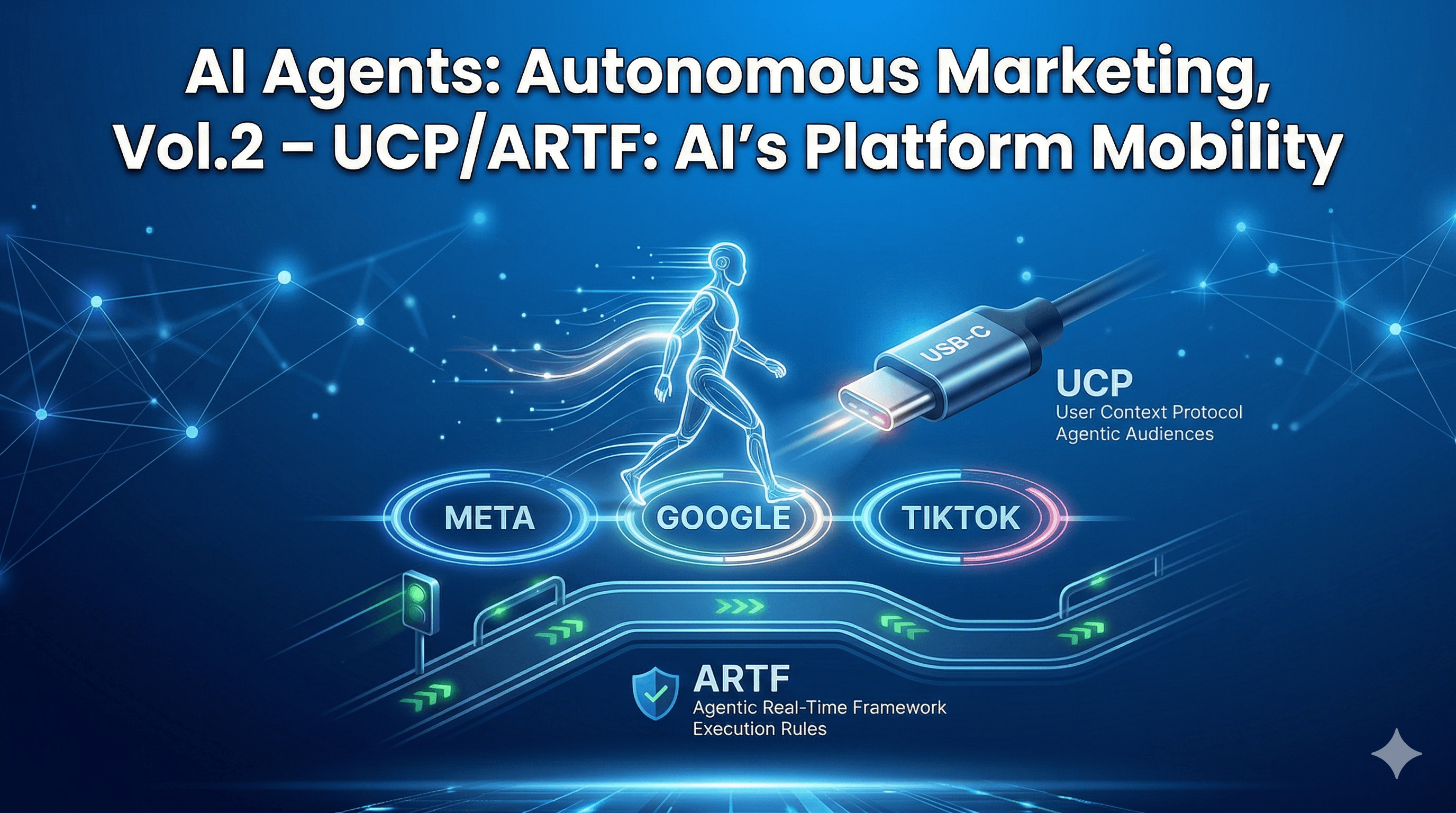
Emerging to realize this "freedom of movement" is UCP (User Context Protocol), which is currently being standardized by the IAB Tech Lab under the name "Agentic Audiences".
Let us clarify the timeline. UCP is a relatively new standard, announced in November 2025 when it was donated by the data company LiveRamp to the IAB Tech Lab. Currently (as of Spring 2026), it is in a phase of rapid testing and development to be integrated into actual production systems.
The USB-C of Data Protocols
Think of UCP's role as unifying power outlets worldwide into a single "USB-C" standard. Under legacy systems, passing "contextual" data—such as user intent or behavior—required sending heavy, text-based data in proprietary formats (like having a different plug shape for every wall). UCP, however, utilizes "embeddings" (in other words, highly compressed, high-dimensional mathematical vectors that AI can instantly comprehend). This standardizes the data just like a universal USB-C cable.
With this "magical outlet," AI Agents can "plug in" their understanding of user intent and creative context into any platform using the exact same format. As a result, the immense benefit of seamlessly connecting creative production, delivery, and measurement across media walls is realized.
Chapter 2: IAB ARTF — "Traffic Rules" to Prevent AI Derailment
However, technological freedom must always be accompanied by "responsibility." If AI Agents move freely across platforms at hyper-speed, executing millions of bids and decisions per second, the risk of systemic derailment skyrockets.
If UCP is the highway allowing data to travel, then IAB's ARTF (Agentic Real-Time Framework) is the "traffic lights and guardrails." The first version (v1.0) of ARTF was also released for public comment in November 2025, and the industry is actively preparing for its widespread deployment right now.
Safety through Execution Rules
ARTF defines the "execution rules" that ensure AI Agents operate safely and deterministically within advertising systems. This standard confines the AI within a secure container (in other words, an isolated, secure box that blocks unauthorized external network access and restricts actions to pre-approved parameters). Furthermore, by forcing AI to explicitly declare its "intent" before taking action, it prevents unpredictable rogue behaviors or the generation of inappropriate content.
Ensuring transparency and safety through ARTF is directly tied to corporate brand protection. By keeping transactions auditable by humans—even when generated and decided by AI—companies can confidently prove, "Our brand is operated within a secure system that adheres to ethics and established rules".
Chapter 3: "Omnipresent AI" Transforms Marketing
The near future, when the infrastructures of UCP (Agentic Audiences) and ARTF are fully established and become mainstream in the advertising market, is projected to arrive between late 2026 and 2027.
When this near-future arrives, advertisers will be completely liberated from the legacy constraint of being "tied down by specific platform specifications." Carrying their data via the universal UCP outlet and protected by the secure guardrails of ARTF, AI Agents will fly freely across the walls of Google, Meta, TikTok, and the open web.
A truly cross-platform, seamless AI marketing ecosystem centered entirely on customer (user) intent, without ever having to consciously navigate platform differences. That is the true form of next-generation creativity brought about by this new infrastructure.
AI Agents: Autonomous Marketing, Vol.1 – AdCP: AI's Creative Language
Discover how AdCP 3.0 equips AI with a universal language to understand ad intent and automate optimization.
Read More →AI Agents: Autonomous Marketing, Vol.3 – CDP/MA: AI's Marketing Brain
Learn how AI Agents, equipped with AdCP, UCP, and ARTF standards, are transforming CDPs and MAs into autonomous marketing brains for execution.
Read More →Have Questions or Want to Learn More?
Contact us for more information about H+ CDP and how it can help your business.
Email us at: antsomi-contact@hakuhodody-one.co.jp
Or, fill out the form below and we'll get back to you shortly.